The map · Before
Your family plan
Planning
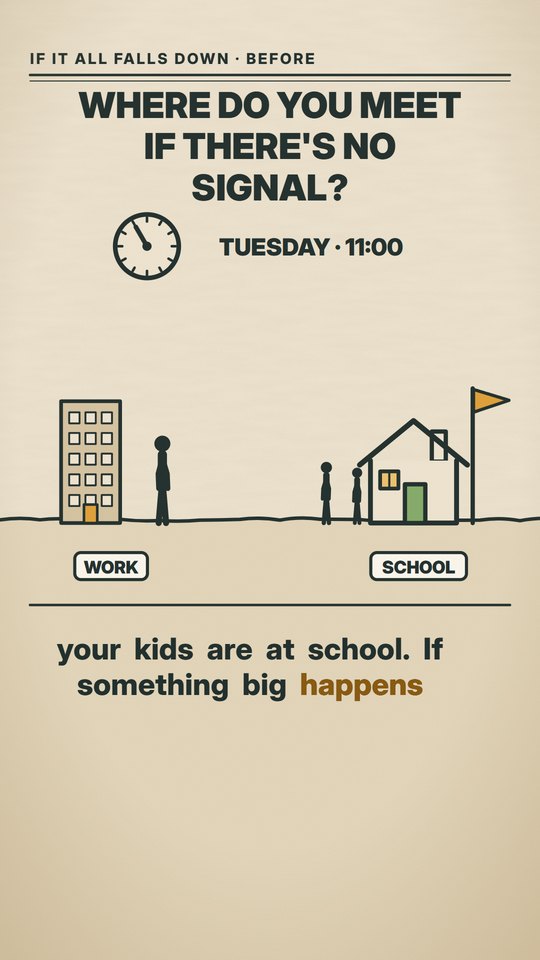
Guidance from both Mexico and the United States recommends the same thing: agree ahead of time with your family on a meeting place, in case a disaster strikes when you're not together. Mexico's CENAPRED suggests somewhere outside the home, in a park or at a relative's or friend's house, and Ready.gov asks that it be familiar and easy to find. Mexico's CENAPRED proposes four steps for your plan: detect and reduce risks, design evacuation routes, make the best decision and run drills. And Ready.gov, in the United States, proposes starting by talking with your family and answering questions: how will you receive alerts, what is your shelter plan, what is your evacuation route, how will you communicate and do you need to update your kit. After that, document the plan and practice it.
Your family plan
Guidance from both Mexico and the United States recommends the same thing: agree ahead of time with your family on a meeting place, in case a disaster strikes when you're not together. Mexico's CENAPRED recommends using the phone only in an emergency, because the lines get saturated. In the United States, the FCC recommends limiting non-emergency calls and keeping all calls brief, and says that with a wireless phone, in many cases a text message will go through when your call may not. Guidance from Mexico and the United States agrees that you should keep the contact details of your family and of other important services at hand. Mexico's CENAPRED asks that the plan take into account children, older people and people with disabilities, and that you include your pets.
To start today, as guidance from Mexico and the United States recommends: agree with your family on a meeting place, in case a disaster strikes when you're not together.
Something to think aboutWhere would your family's meeting place be?
Learn more
What is claimed and why
- The CENAPRED leaflet «Elabora tu Plan Familiar de Protección Civil» (Mexico) recommends agreeing with relatives on a meeting place in case the disaster strikes while they are dispersed, and says it can be a friend's or a relative's home; its 2019 pocket plan proposes a meeting point outside the home, in a park or with a relative. Ready.gov (U.S.) says the family may not be together if a disaster strikes and recommends establishing a family meeting place that is familiar and easy to find; FEMA's family communication plan guide recommends deciding on safe, familiar places where the family can go for protection or to reunite. official guidanceCENAPRED (Mexico's National Center for Disaster Prevention), Prepare Your Family Civil Protection Plan (leaflet) — p. 24 Lugar de reuniónCENAPRED (Mexico's National Center for Disaster Prevention), Family Civil Protection Plan (pocket version) — Cara 1 Punto de reuniónReady.gov (FEMA, U.S. Department of Homeland Security), Make A Plan — Make A Plan ¶1; Make A Plan ¶1
Your family may not be together if a disaster strikes
Establish a family meeting place that’s familiar and easy to find.
FEMA (U.S. federal government), Create Your Family Emergency Communication Plan (FEMA P-1094) — p. 2 Emergency meeting places ¶1Decide on safe, familiar places where your family can go for protection or to reunite.
- The CENAPRED leaflet (Mexico) proposes preparing the Family Civil Protection Plan in four steps: detect and reduce risks, design evacuation routes, make the best decision and run drills. Ready.gov (U.S.) proposes starting the plan by discussing with family, friends or household these questions: how will I receive emergency alerts and warnings, what is my shelter plan, what is my evacuation route, what is my family/household communication plan and do I need to update my emergency preparedness kit; then customizing the plans and supplies to the household's daily living needs and responsibilities, documenting the plan with a fillable form and practicing it. official guidanceCENAPRED (Mexico's National Center for Disaster Prevention), Prepare Your Family Civil Protection Plan (leaflet) — p. 4 Cuatro pasosReady.gov (FEMA, U.S. Department of Homeland Security), Make A Plan — Step 1 ¶1; Step 1 ¶2; Step 1 ¶3; Step 1 ¶4; Step 1 ¶5; Step 1 ¶6; Step 3 ¶1; Step 4 ¶1
Put a plan together by discussing the questions below with your family, friends or household to start your emergency plan.
How will I receive emergency alerts and warnings?
What is my shelter plan?
What is my evacuation route?
What is my family/household communication plan?
Do I need to update my emergency preparedness kit?
Create your family emergency plan quickly and easily using our fillable form.
Practice your plan with your household.
- The CENAPRED leaflet (Mexico) recommends using the phone only in an emergency, because the lines get saturated. The FCC (U.S.) recommends limiting non-emergency calls, keeping all calls brief and, when using a wireless phone, trying text messages, which in many cases go through when a call may not; FEMA explains that, if you are using a mobile phone, a text message may get through when a phone call will not because it requires far less bandwidth. official guidanceCENAPRED (Mexico's National Center for Disaster Prevention), Prepare Your Family Civil Protection Plan (leaflet) — p. 24 TeléfonoFCC (U.S. Federal Communications Commission), Tips for Communicating in an Emergency — Recommended Practices for All Users ¶1; Recommended Practices for All Users ¶2; Recommended Practices for All Users ¶3
Limit non-emergency phone calls.
Keep all phone calls brief.
In many cases text messages will go through when your call may not.
FEMA (U.S. federal government), Create Your Family Emergency Communication Plan (FEMA P-1094) — p. 1 Texta text message may get through when a phone call will not
- The CENAPRED leaflet (Mexico) recommends having a directory with the phone numbers and addresses of the Red Cross, IMSS, ISSSTE, the family doctor, the fire department, the state and municipal civil protection units and the municipality or political delegation; its 2019 pocket plan includes a directory of relatives and emergency services in the list of what to keep at hand in the emergency backpack. FEMA (U.S.) recommends creating a paper copy of the contact information for the family and other important people and offices, such as medical facilities, doctors, schools or service providers, and that everyone carries a copy in a backpack, purse or wallet. official guidanceCENAPRED (Mexico's National Center for Disaster Prevention), Prepare Your Family Civil Protection Plan (leaflet) — p. 22 DirectorioCENAPRED (Mexico's National Center for Disaster Prevention), Family Civil Protection Plan (pocket version) — Cara 1 MochilaFEMA (U.S. federal government), Create Your Family Emergency Communication Plan (FEMA P-1094) — p. 1 Collect; p. 1 Share
Create a paper copy of the contact information for your family and other important people/offices, such as medical facilities, doctors, schools, or service providers.
Make sure everyone carries a copy in his or her backpack, purse, or wallet.
- The CENAPRED leaflet (Mexico) says the plan should consider the participation of children, people with different abilities and older adults, and reminds that evacuating them often takes more time, so the help they may need should be considered; its 2019 pocket plan asks to adapt the plan to each person's needs (girls and boys, older people, people with disabilities) and to include pets. Ready.gov (U.S.) asks to customize the plan and supplies to the household's daily living needs and responsibilities, and lists the different ages, medical needs, disabilities or access and functional needs, and pets or service animals. official guidanceCENAPRED (Mexico's National Center for Disaster Prevention), Prepare Your Family Civil Protection Plan (leaflet) — p. 2 Organízate ¶1; p. 20 Decisiones ¶2CENAPRED (Mexico's National Center for Disaster Prevention), Family Civil Protection Plan (pocket version) — Cara 2 Plan ¶2Ready.gov (FEMA, U.S. Department of Homeland Security), Make A Plan — Step 2 ¶1; Step 2 ¶2; Step 2 ¶6; Step 2 ¶7; Step 2 ¶10
customize your plans and supplies to your specific daily living needs and responsibilities.
Different ages of members within your household
Medical needs including prescriptions and equipment
Disabilities or access and functional needs including devices and equipment
Pets or service animals
- Ready.gov (U.S.) recommends establishing a family meeting place that is familiar and easy to find. FEMA's family communication plan guide recommends deciding on safe, familiar places where the family can go for protection or to reunite, and proposes identifying several. For meeting up, it proposes a place in your neighborhood, if there is a fire or other emergency and you need to leave home (for example, a big tree, the mailbox at the end of the driveway or a neighbor's house); another outside your neighborhood, if a disaster happens when you're not at home and can't get back (for example, a library, community center, house of worship or family friend's home); and another outside your town or city, which can help you reunite if you cannot get home or to the out-of-neighborhood place, or your family is not together and your community is told to evacuate. official guidanceUnited StatesReady.gov (FEMA, U.S. Department of Homeland Security), Make A Plan — Make A Plan ¶1
Establish a family meeting place that’s familiar and easy to find.
FEMA (U.S. federal government), Create Your Family Emergency Communication Plan (FEMA P-1094) — p. 2 Emergency meeting places ¶1; p. 2 Emergency meeting places: in your neighborhood; p. 2 Emergency meeting places: outside of your neighborhood; p. 3 Emergency meeting places: outside of your townDecide on safe, familiar places where your family can go for protection or to reunite.
This is a place in your neighborhood where your household members will meet if there is a fire or other emergency and you need to leave your home.
This is a place where your family will meet if a disaster happens when you’re not at home and you can’t get back to your home.
Having an out-of-town meeting place can help you reunite if a disaster happens
- FEMA (U.S.) recommends identifying someone outside your community or state who can act as a central point of contact to help your household reconnect, because in a disaster it may be easier to make a long-distance call than to call across town, since local phone lines can be jammed. The FCC (U.S.) also recommends designating someone out of the area as a central contact and making certain all family members know who to contact if they become separated. official guidanceUnited StatesFEMA (U.S. federal government), Create Your Family Emergency Communication Plan (FEMA P-1094) — p. 2 Out of town contact; p. 2 Out of town contact
identify someone outside of your community or State who can act as a central point of contact to help your household reconnect
it may be easier to make a long-distance phone call than to call across town because local phone lines can be jammed
FCC (U.S. Federal Communications Commission), Tips for Communicating in an Emergency — Recommended Practices for All Users ¶9Designate someone out of the area as a central contact, and make certain all family members know who to contact if they become separated
- Ready.gov (U.S.) recommends practicing the plan with your household. FEMA's family communication plan guide recommends reviewing, updating and practicing the plan at least once a year, or whenever any of your information changes, and after practicing, talking about how it went, what worked well and what can be improved. official guidanceUnited StatesReady.gov (FEMA, U.S. Department of Homeland Security), Make A Plan — Step 4 ¶1
Practice your plan with your household.
FEMA (U.S. federal government), Create Your Family Emergency Communication Plan (FEMA P-1094) — p. 4 Practice frequency; p. 4 Practice reviewReview, update, and practice your Family Emergency Communication Plan at least once a year, or whenever any of your information changes.
After you practice, talk about how it went. What worked well? What can be improved?
This is educational material. In a real emergency, follow the instructions of your local emergency management and officials.