The map · Before
The two-week kit
WaterFoodHealth
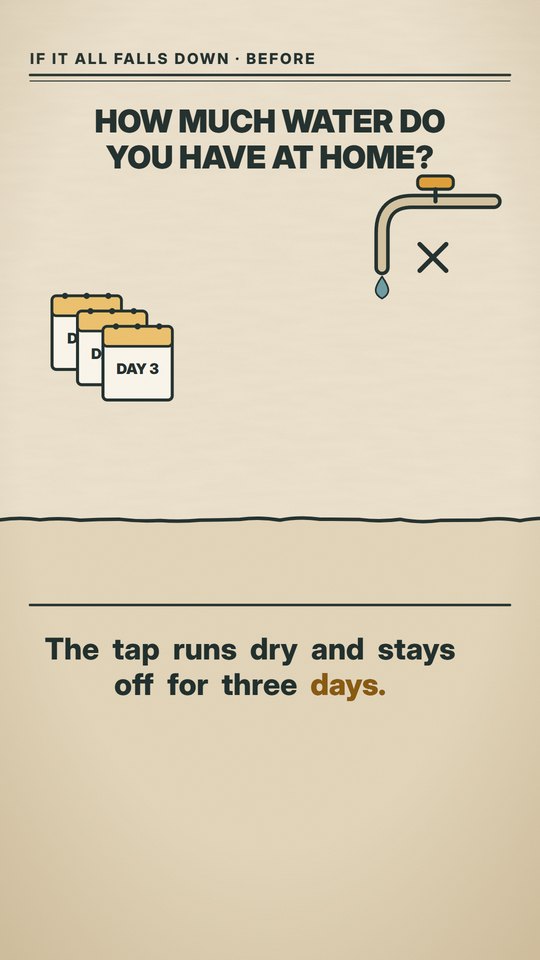
Mexico's CENAPRED asks you to have what you need for your basic needs during the first 72 hours. And Ready.gov, in the United States, says that after an emergency you may need to get by on your own for several days, and asks you to have your own food, water and other supplies to last for several days. Mexico's CENAPRED asks for bottled water for two days in your backpack, preferably still. And the CDC, in the United States, gives a number: at least one gallon, about 3.8 liters, per person, per day, for three days, for drinking, cooking and brushing your teeth. And, if possible, a two-week supply.
How many days would it last?
Mexico's CENAPRED asks for bottled water for two days in your backpack, preferably still. And the CDC, in the United States, gives a number: at least one gallon, about 3.8 liters, per person, per day, for three days, for drinking, cooking and brushing your teeth. And, if possible, a two-week supply. Beyond water, guidance from both countries agrees on the basics: food that won't spoil, a radio, a flashlight, extra batteries and a first aid kit. And both ask you to think about your medicines and your important documents. Mexico's CENAPRED asks you to check the expiration dates of food and medicines often, and replace them if needed. Ready.gov, to replace expired items as needed and, every year, rethink what you need. And the CDC, to replace water you bottle yourself every six months.
To start today: pick where your kit will live. Ready.gov asks you to keep it in a designated place, and for everyone in your family to know where it is. Mexico's CENAPRED asks for somewhere visible and accessible.
Something to think aboutHow many days would the water you have today last your family?
Learn more
What is claimed and why
- The CENAPRED «Mochila de emergencia» pocket leaflet (Mexico) says that, whatever the type of emergency or disaster, you should have what you need to meet your basic needs during the first 72 hours. Ready.gov (U.S.) says that after an emergency you may need to survive on your own for several days, and that being prepared means having your own food, water and other supplies to last for several days. official guidanceCENAPRED (Mexico's National Center for Disaster Prevention), Emergency backpack (pocket version) — Cara 2 Recuerda 72 horasReady.gov (FEMA, U.S. Department of Homeland Security), Build A Kit — Build A Kit ¶1
After an emergency, you may need to survive on your own for several days. Being prepared means having your own food, water and other supplies to last for several days.
- The CENAPRED article «Prepara una mochila de emergencia para toda la familia» (2017) lists among the essential items of the backpack canned food and bottled water for two days, and its article «Mochila de emergencia. ¡Prepárala!» (2018) recommends bottled water, preferably still. The CDC (U.S.) recommends storing at least 1 gallon (about 3.8 liters) of water per person, per day for 3 days, which can be used for drinking, cooking, brushing teeth and other uses, and trying to store a 2-week supply if possible. official guidanceCENAPRED (Mexico's National Center for Disaster Prevention), Prepare an emergency backpack for the whole family (gob.mx article) — ¶3 IndispensablesCENAPRED (Mexico's National Center for Disaster Prevention), Emergency backpack: get it ready! (gob.mx article) — AguaCENAPRED (Mexico's National Center for Disaster Prevention), Prepare Your Family Civil Protection Plan (leaflet) — p. 26 Procura tenerU.S. Centers for Disease Control and Prevention (CDC), How to Create an Emergency Water Supply — How much ¶1
Store at least 1 gallon of water per person, per day for 3 days. You can use this water during an emergency for drinking, cooking, brushing teeth, and other uses. Try to store a 2-week supply if possible.
- CENAPRED's 2017 article lists among the essential items of the emergency backpack important documents, a directory, canned food and bottled water, a first aid kit, tools for emergency repairs, and a radio and flashlight with batteries; its pocket leaflet reminds you to have spare batteries or use dynamo-charged devices, and to include the medicines and special items your family needs; its 2018 article says canned food is always a good option and asks you to choose light, single-serving, easy-to-open foods that give energy. Ready.gov's basic kit includes, among other things, water, non-perishable food, a battery-powered or hand crank radio, a flashlight, a first aid kit and extra batteries; it suggests considering adding, based on your needs, prescription medications and important family documents; and its food page asks for canned foods and other staples that do not require refrigeration, cooking, water or special preparation, plus a manual can opener. official guidanceCENAPRED (Mexico's National Center for Disaster Prevention), Prepare an emergency backpack for the whole family (gob.mx article) — ¶3 IndispensablesCENAPRED (Mexico's National Center for Disaster Prevention), Emergency backpack (pocket version) — Cara 1 Recomendaciones Pilas; Cara 2 MedicamentosCENAPRED (Mexico's National Center for Disaster Prevention), Emergency backpack: get it ready! (gob.mx article) — AlimentosReady.gov (FEMA, U.S. Department of Homeland Security), Build A Kit — Basic Kit Food; Basic Kit Radio; Basic Kit Flashlight; Basic Kit First aid; Basic Kit Batteries; Additional ¶1; Additional Prescriptions; Additional Documents
Food (at least a several-day supply of non-perishable food)
Battery-powered or hand crank radio
Flashlight
First aid kit
Extra batteries
Consider adding the following items to your emergency supply kit based on your individual needs:
Prescription medications.
Important family documents
Ready.gov (FEMA, U.S. Department of Homeland Security), Food — Food ¶1Stock canned foods, dry mixes and other staples that do not require refrigeration, cooking, water or special preparation. Be sure to include a manual can opener and eating utensils.
- CENAPRED's «Mochila de emergencia» pocket leaflet says that, if there are power cuts, you will need to stay informed and have light, and that is why you should have batteries for the radio and a lamp. Ready.gov, on its radiation emergencies page, recommends having a battery-powered or hand crank radio, which will continue to work if other forms of communication fail. official guidanceCENAPRED (Mexico's National Center for Disaster Prevention), Emergency backpack (pocket version) — Cara 1 Para qué equiparseReady.gov (FEMA, U.S. Department of Homeland Security), Radiation Emergencies — Prepare NOW ¶2
Have a battery-powered or hand crank radio, which will continue to work if other forms of communication fail.
- CENAPRED's «Mochila de emergencia» pocket leaflet asks you to check the expiration dates of food and medicines often and replace them if necessary. Ready.gov asks, to maintain the kit, to replace expired items as needed and to re-think your needs every year, updating the kit as your family's needs change. The CDC recommends that, if you fill containers with water to store yourself, you replace the water every 6 months. official guidanceCENAPRED (Mexico's National Center for Disaster Prevention), Emergency backpack (pocket version) — Cara 1 Recomendaciones CaducidadReady.gov (FEMA, U.S. Department of Homeland Security), Build A Kit — Maintaining Expired; Maintaining Every year
Replace expired items as needed.
Re-think your needs every year and update your kit as your family’s needs change.
U.S. Centers for Disease Control and Prevention (CDC), How to Create an Emergency Water Supply — Other ReplaceIf you are filling containers with water to store, replace the water every 6 months.
- CENAPRED's «Mochila de emergencia» pocket leaflet says the backpack should be placed somewhere visible and accessible, and its 2018 article adds that preferably in the safest area or along the previously identified evacuation route. Ready.gov asks you to keep the home kit in a designated place, ready in case you have to leave home quickly, and to make sure all family members know where it is kept. official guidanceCENAPRED (Mexico's National Center for Disaster Prevention), Emergency backpack (pocket version) — Cara 1 Recomendaciones LugarCENAPRED (Mexico's National Center for Disaster Prevention), Emergency backpack: get it ready! (gob.mx article) — ¶1 LugarReady.gov (FEMA, U.S. Department of Homeland Security), Build A Kit — Storage Home
Home: Keep this kit in a designated place and have it ready in case you have to leave your home quickly. Make sure all family members know where the kit is kept.
This is educational material. In a real emergency, follow the instructions of your local emergency management and officials.