The map · Before
What a nuclear weapon actually does
Understanding
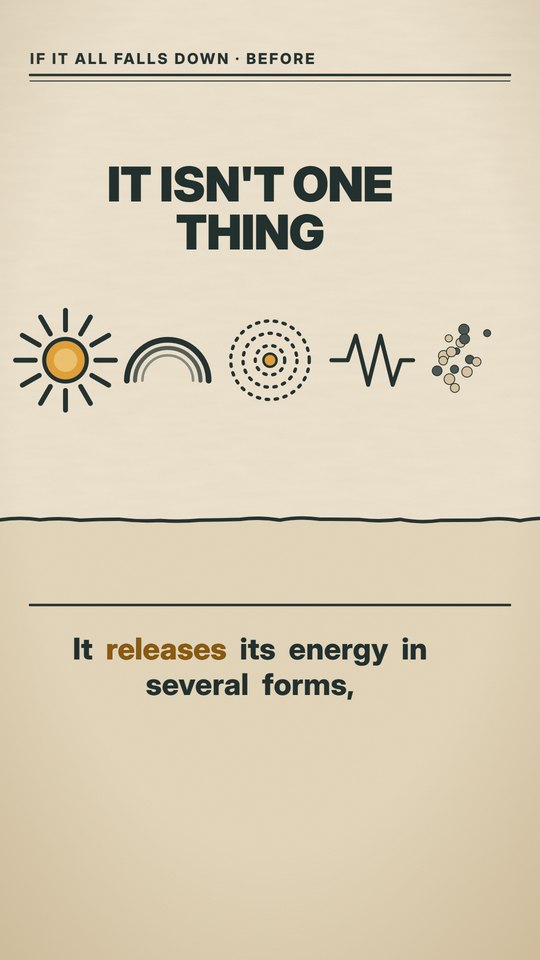
A nuclear explosion isn't one thing: it releases its energy in several forms. The flash comes first, traveling at the speed of light, and the blast wave arrives seconds later. Fallout weakens fast, though in real life it has to be measured.
It isn't one thing
A nuclear explosion releases its energy in several forms: flash, blast wave, direct radiation, electromagnetic pulse and fallout. The flash arrives seconds before the blast.
To start today
Find out how your local emergency management would alert you in an emergency.
Something to think aboutWhich spot in your home has the most walls between you and the street?
Learn more
What is claimed and why
- The energy of a nuclear explosion is released in several forms: a blast wave, thermal radiation (mostly visible light), initial nuclear radiation, an electromagnetic pulse, and radioactive particles that fall back to Earth as fallout. scientific consensusOffice of Technology Assessment, U.S. Congress, The Effects of Nuclear War — II General Description Of Effects ¶1; II General Description Of Effects ¶3; II General Description Of Effects ¶4; II Direct Nuclear Radiation ¶1Samuel Glasstone and Philip J. Dolan (eds.), The Effects of Nuclear Weapons (3rd ed.) — 1.26; 1.38
- As a rough rule, for a fission weapon exploded in the air below about 40,000 feet (12,000 meters), about 50 percent of the energy produces the blast wave and about 35 percent comes out as thermal radiation. About 15 percent is released as nuclear radiation: 5 percent is the initial radiation (within a minute or so) and 10 percent the residual radiation, emitted over time. scientific consensusSamuel Glasstone and Philip J. Dolan (eds.), The Effects of Nuclear Weapons (3rd ed.) — 1.25; 1.26Office of Technology Assessment, U.S. Congress, The Effects of Nuclear War — II Thermal Radiation ¶1
- Thermal radiation travels at the speed of light, so the flash of light and heat arrives several seconds before the blast wave, just as lightning is seen before thunder is heard. The blast moves far more slowly: for a 1-megaton explosion, after 10 seconds its front is some 3 miles (5 km) ahead of the fireball, and after 50 seconds it has traveled about 12 miles (19 km). scientific consensusOffice of Technology Assessment, U.S. Congress, The Effects of Nuclear War — II Thermal Radiation ¶1Samuel Glasstone and Philip J. Dolan (eds.), The Effects of Nuclear Weapons (3rd ed.) — 2.32
- The flash can cause temporary blindness (flashblindness) even without looking straight at the fireball, since scattered light is enough. It lasts from a few seconds to several minutes, and recovery is complete. But if the image of the fireball is focused in the eye, it can cause a retinal burn, which is permanent. scientific consensusSamuel Glasstone and Philip J. Dolan (eds.), The Effects of Nuclear Weapons (3rd ed.) — 12.83; 12.84Office of Technology Assessment, U.S. Congress, The Effects of Nuclear War — II Thermal Radiation ¶2
- Thermal radiation behaves like sunlight: opaque materials largely stop it, so buildings and clothing can provide protection, and objects cast shadows behind which the radiation is indirect (reflected) and less intense. In Hiroshima and Nagasaki, generally any type of shielding protected the skin against flash burns, although near the center burns through one (and very occasionally more) layers of clothing did occur. scientific consensusSamuel Glasstone and Philip J. Dolan (eds.), The Effects of Nuclear Weapons (3rd ed.) — 1.33Office of Technology Assessment, U.S. Congress, The Effects of Nuclear War — II Thermal Radiation ¶4Manhattan Engineer District, U.S. Army, The Atomic Bombings of Hiroshima and Nagasaki — Burns ¶4
- The blast wave produces sudden changes in air pressure and very high winds. For the most part it kills by indirect means rather than by direct pressure: most blast deaths result from the collapse of occupied buildings, from people being blown into objects, and from objects being blown into people, such as debris that strikes or penetrates. scientific consensusOffice of Technology Assessment, U.S. Congress, The Effects of Nuclear War — II Blast ¶1; II Blast ¶6Samuel Glasstone and Philip J. Dolan (eds.), The Effects of Nuclear Weapons (3rd ed.) — 12.39
- In Hiroshima and Nagasaki, the death rate was greatest among people in the open, lower in residential (wood-frame and plaster) structures, and lowest in concrete buildings. Between about 0.3 and 0.75 mile (0.5 to 1.2 km) from ground zero, fatalities in the open ranged from about 90 to 100 percent, while people inside reinforced-concrete buildings were safer, even with no warning or protective action; even so, in the two concrete buildings closest to ground zero the mortality rate was 88 percent. Having a large, substantial object between a person and the explosion gave some protection from the blast, though the magnitude of the explosions and the great height of the bursts made that effect markedly different from an ordinary bomb's. historical recordSamuel Glasstone and Philip J. Dolan (eds.), The Effects of Nuclear Weapons (3rd ed.) — 12.17; 12.21; 12.22Manhattan Engineer District, U.S. Army, The Atomic Bombings of Hiroshima and Nagasaki — Shielding, Or Screening From Blast ¶1
- Initial nuclear radiation is the radiation produced within a minute or so of the explosion, mainly gamma rays and neutrons, which can be neither seen nor felt except at very high intensities, which cause a tingling sensation. It can be very intense, but its range is limited: for large weapons, the range of intense direct radiation is less than that of lethal blast and thermal effects; for smaller weapons it may be the lethal effect with the greatest range. scientific consensusSamuel Glasstone and Philip J. Dolan (eds.), The Effects of Nuclear Weapons (3rd ed.) — 1.26; 1.28Office of Technology Assessment, U.S. Congress, The Effects of Nuclear War — II Direct Nuclear Radiation ¶1; II Direct Nuclear Radiation ¶2
- The explosion produces an electromagnetic pulse (EMP): a wave similar to radio waves, but with much higher electric field strengths, lasting a fraction of a second. There is no evidence that EMP is a physical threat to humans, but it can damage or upset electrical and electronic equipment, particularly equipment connected to long wires such as power lines or antennas. scientific consensusOffice of Technology Assessment, U.S. Congress, The Effects of Nuclear War — II Electromagnetic Pulse ¶1; II Electromagnetic Pulse ¶3Samuel Glasstone and Philip J. Dolan (eds.), The Effects of Nuclear Weapons (3rd ed.) — 1.38
- Fallout consists of particles (earth and other debris lifted by the explosion) contaminated with radioactive material, which fall back to Earth. It is far greater if the burst is on the surface or low enough for the fireball to touch the ground; an explosion farther above the surface than the radius of the fireball produces negligible immediate fallout. scientific consensusOffice of Technology Assessment, U.S. Congress, The Effects of Nuclear War — II Fallout ¶1; II Blast ¶5Samuel Glasstone and Philip J. Dolan (eds.), The Effects of Nuclear Weapons (3rd ed.) — 1.35; 9.02
- The particles that rise higher are carried by the wind before returning to Earth, much of the material blown downwind in a long plume, so the area and intensity of the fallout are strongly influenced by local weather. They may be dispersed over large areas, and their effects may be felt at distances well beyond the range of the other effects of the explosion. scientific consensusOffice of Technology Assessment, U.S. Congress, The Effects of Nuclear War — II Fallout ¶3Samuel Glasstone and Philip J. Dolan (eds.), The Effects of Nuclear Weapons (3rd ed.) — 9.02
- For a fixed amount of fallout already deposited, the dose rate drops quickly at first. Approximate rule: for every sevenfold increase in time after the explosion, the dose rate decreases by a factor of ten. Taking 1 hour after the explosion as the reference, at 7 hours it is one-tenth, at 49 hours (roughly 2 days) one-hundredth, and at about 2 weeks one-thousandth. It is only an approximation, useful for illustration and some planning; if more fallout comes down, is removed, or there are several detonations, the rate changes, so in a real situation it has to be measured. scientific consensusSamuel Glasstone and Philip J. Dolan (eds.), The Effects of Nuclear Weapons (3rd ed.) — 9.15Office of Technology Assessment, U.S. Congress, The Effects of Nuclear War — II Fallout ¶4
This is educational material. In a real emergency, follow the instructions of your local emergency management and officials.