The map · Before
Nuclear war myths
Understanding
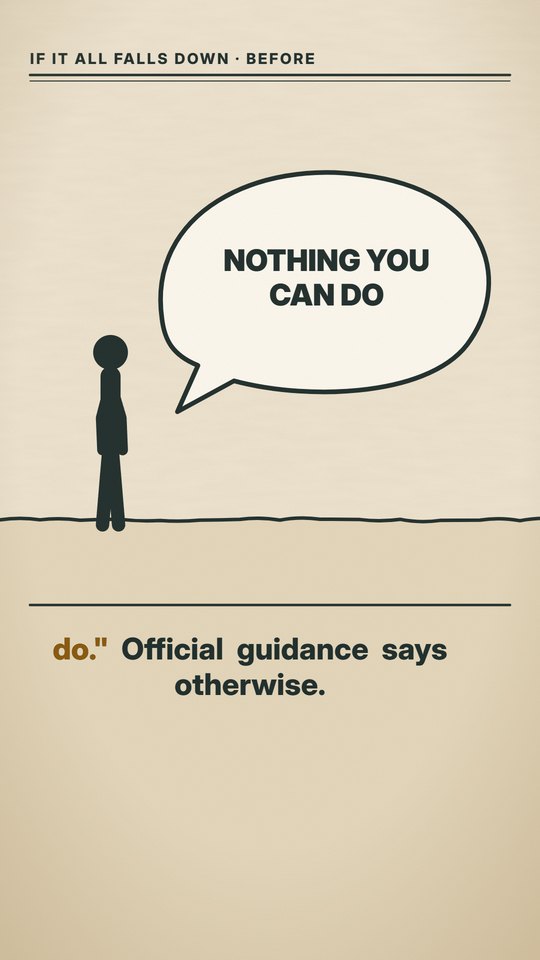
The guidance from FEMA, the U.S. emergency management agency, observes that the public tends to associate a nuclear explosion with certain death, and that this fatalism severely impacts their ability to follow instructions. According to that guide, without preparation people will likely follow the instinct to run, and could expose themselves to fatal doses of radiation that sheltering could avoid. And fallout doesn't stay just as strong: according to U.S. guidance, it becomes much less dangerous over the first twenty-four hours.
"There's nothing you can do" and other myths
Four ideas that official guidance contradicts: that there's nothing you can do, that the best thing is to run, that iodine protects you from radiation, and that radiation lasts forever. The advice from WHO and U.S. guidance fits in three steps: get inside, stay inside until it is safe to leave, and stay tuned to follow the authorities' instructions.
Find the room the World Health Organization advises: if possible, one in your home with no windows or outside doors.
Something to think aboutWhich of these myths had you heard, and from whom?
Learn more
What is claimed and why
- FEMA's planning guidance (U.S., 2022) observes that the public associates nuclear detonations with certain death, and that this sense of futility, fatalism and hopelessness severely impacts their desire and ability to absorb information and follow instructions. The same guide states that with careful planning many lives can be saved, and that in its scenario of a near-surface detonation in a U.S. city (the kind that produces fallout), sheltering in downwind areas can potentially save hundreds of thousands of people from significant radiation exposure. Ready.gov (U.S.) says you can keep your family safe by knowing what to do and being prepared. official guidanceFEMA (U.S. federal interagency committee), Planning Guidance for Response to a Nuclear Detonation (3rd ed.) — p. 118 ¶2; p. 1 ¶1; p. 16 ¶2
with a public that associates nuclear detonations with certain death, the sense of futility, fatalism, and hopelessness severely impacts their desire and ability to absorb information and follow instructions
With careful planning, many lives can be saved
Sheltering in downwind areas can potentially save hundreds of thousands of people from significant radiation exposure.
Ready.gov (FEMA, U.S. Department of Homeland Security), Radiation Emergencies — Radiation Emergencies ¶1You can keep your family safe by knowing what to do and being prepared if an incident occurs.
- FEMA's planning guidance (U.S., 2022) says that in a nuclear detonation, without pre-incident knowledge, key messaging and preparedness steps, people will likely follow the instinct to run from danger, potentially exposing themselves to fatal doses of radiation that could be avoided by sheltering. WHO advises that if you have been instructed to stay inside, you should do so, as walls and ceilings can provide protection from radioactive fallout outside. official guidanceFEMA (U.S. federal interagency committee), Planning Guidance for Response to a Nuclear Detonation (3rd ed.) — p. 118 ¶1
Without pre-incident knowledge, key messaging, and preparedness steps, people will likely follow the instinct to run from danger, potentially exposing themselves to fatal doses of radiation that could be avoided by sheltering.
World Health Organization (WHO), Radiation and health (Q&A) — Q&A ¶14World Health Organization (WHO), Radiation and health (Q&A, Spanish) — Q&A ¶14 - U.S. guidance (Ready.gov; FEMA, 2022) gives as a planning figure that after a detonation there are 10 minutes or more to find adequate shelter before fallout arrives (FEMA: likely, for a near-surface detonation that produces it). Ready.gov says that if a multi-story building or a basement can be safely reached within a few minutes, you should go there immediately. official guidanceUnited StatesReady.gov (FEMA, U.S. Department of Homeland Security), Radiation Emergencies — Stay Safe DURING ¶6
After a detonation, you will have 10 minutes or more to find an adequate shelter before fallout arrives. If a multi-story building or a basement can be safely reached within a few minutes of the explosion, go there immediately.
FEMA (U.S. federal interagency committee), Planning Guidance for Response to a Nuclear Detonation (3rd ed.) — p. 54 Radiation; p. 54 Public actionsFallout will likely take 10 minutes or more to arrive.
There will be 10 minutes or more after the detonation to find adequate protection before fallout arrives.
- WHO makes clear that potassium iodide (KI) is not an antidote for radiation exposure. According to WHO and the CDC (U.S.), it protects only the thyroid, and only against radioactive iodine; it does not protect against other radioactive substances or against external radiation, for example from radioactivity deposited on the ground. The CDC adds that this is why it will not help in a nuclear bomb emergency: fallout is made up of hundreds of radioactive materials and has a relatively small amount of radioactive iodine. Iodized table salt is not a substitute, and eating excessive amounts can be harmful. KI should be taken only when public health authorities say so. official guidanceWorld Health Organization (WHO), Use of potassium iodide for thyroid protection during nuclear or radiological emergencies (Q&A) — Q&A ¶6; Q&A ¶7; Q&A ¶8; Q&A ¶11; Q&A ¶12U.S. Centers for Disease Control and Prevention (CDC), Potassium Iodide (KI) — Limits of KI use ¶4; Limits of KI use ¶5; KI will not help in a nuclear bomb emergency ¶1; KI will not help in a nuclear bomb emergency ¶3; Use KI only if instructed ¶3
KI protects only against radioactive iodine and does not protect against other types of radioactive materials.
KI protects only the thyroid. KI does not protect other parts of the body.
Fallout is made up of hundreds of types of radioactive materials.
There is a relatively small amount of radioactive iodine in fallout
Do not use table salt or foods that contain iodine as a substitute for KI.
- Because many fission products are short-lived, fallout radiation decreases rapidly with time: it gives off over half of its energy in the first hour and then continues to decay rapidly (FEMA, 2022). Ready.gov says radiation levels decrease rapidly, becoming significantly less dangerous, during the first 24 hours. Glasstone and Dolan give an approximate rule for a fixed quantity of fallout: for every sevenfold increase in time after the explosion, the dose rate decreases by a factor of ten. They caution that it is only an approximation (accurate to within about 25 percent up to about 2 weeks), useful for illustration and some planning, and that in a real situation measurements are needed. scientific consensusFEMA (U.S. federal interagency committee), Planning Guidance for Response to a Nuclear Detonation (3rd ed.) — p. 33 ¶1
Fallout gives off over half of its energy in the first hour and then continues to decay rapidly
Ready.gov (FEMA, U.S. Department of Homeland Security), Radiation Emergencies — Stay Safe DURING ¶7Radiation levels decrease rapidly, becoming significantly less dangerous, during the first 24 hours.
Samuel Glasstone and Philip J. Dolan (eds.), The Effects of Nuclear Weapons (3rd ed.) — 9.15for every sevenfold increase in time after the explosion, the dose rate decreases by a factor of ten
- WHO sums up protection in a radiation emergency in three actions: get inside, stay inside until it is safe to leave, and tune in to follow instructions from local and national authorities. U.S. guidance (Ready.gov, CDC) says the same (get inside, stay inside, stay tuned). Once inside, WHO advises, if possible, a room with no windows or external doors, and Ready.gov advises moving away from windows. official guidanceWorld Health Organization (WHO), Radiation and health (Q&A) — Q&A ¶18; Q&A ¶14Ready.gov (FEMA, U.S. Department of Homeland Security), Radiation Emergencies — Radiation Emergencies ¶2; Stay Safe DURING ¶3
The best way to stay safe in any radiation emergency is to get inside, stay inside and stay tuned.
immediately get inside the nearest building and move away from windows
U.S. Centers for Disease Control and Prevention (CDC), Potassium Iodide (KI) — Reminder ¶1
This is educational material. In a real emergency, follow the instructions of your local emergency management and officials.